




The Ultimate South African Flooring Guide: Part 8
DIY vs Professional Installation: Finding the Right Fit
Deciding between a DIY flooring project and hiring a professional installer is a major renovation milestone. Thanks to advanced click-lock technologies, DIY is more accessible and rewarding than ever.
However, there is no one-size-fits-all answer. Your ideal route depends heavily on three key factors:
- The specific flooring type (Laminate, SPC, or LVT)
- Your current power tool collection
- The layout and complexity of your rooms
Whether you want the immense satisfaction of a budget-saving weekend project or the hands-off convenience of a pro, here is your objective guide to making the right call.
1. The Realities of the Job: Tools and Technique
When comparing a DIY project to a professional quote, it helps to look beyond just the hourly labour rate and understand exactly what the project entails.
🛠️ Building Your Tool Kit (Floating Floors)
A great DIY project requires great tools. To execute a flawless installation, you will need to purchase or hire:
- A high-quality jigsaw or mitre saw for precise plank cutting.
- A dedicated installation kit (tapping block, pull bar, spacers).
- A rubber mallet, carpenter’s square, and heavy-duty utility knives.
If you already own these, your DIY savings will be massive.
📐 The Learning Curve Buffer (Wastage)
Professionals strictly keep material wastage to the standard 10%.
When tackling a project for the first time, order 15% to 20% wastage. This buffer allows you to practice tricky cuts around door frames without the stress of running out of planks.
2. Material Breakdown: What Can You Actually DIY?
The type of floor you purchased is the biggest factor in deciding who should install it.
✅ Laminate Flooring: The DIY Favourite
DIY Suitability: High
- The Installation: Utilizes a drop-lock or click-lock mechanism where planks simply snap together.
- Requirements: Must lay down a suitable underlay and DPM over concrete.
- The Golden Rule: You must leave a 10mm expansion gap around the entire perimeter.
✅ SPC Rigid Core: The Waterproof Upgrade
DIY Suitability: High
- The Installation: Straightforward click-lock floating system.
- Requirements: SPC requires 24 to 48 hours to acclimatise.
- The Subfloor: Forgiving over minor imperfections, but requires a flat and smooth base.
🛑 LVT (Glue-Down): The Advanced DIY Project
DIY Suitability: Moderate (Requires Experience)
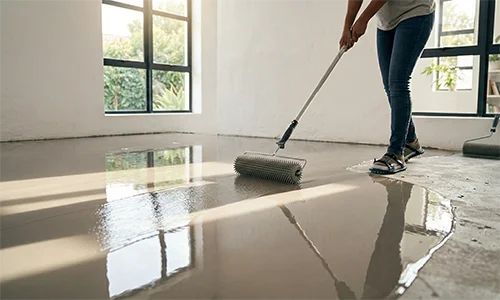
Smoothing Screed
Preparing the subfloor for LVT is significantly more challenging than a click-lock system.
- Tool Requirements: Requires a gauge rake, spiked shoes, and a spiked roller for the screed.
- The Challenge: LVT will mould to the exact shape of the floor beneath it, requiring a glass-smooth cement-based smoothing compound.
- The Advantage: Securely glued down, LVT requires zero expansion gaps for a seamless transition.
3. Pros and Cons: Making the Final Call
The DIY Approach
Pros:
- Cost Savings: Eliminate professional labour costs.
- Satisfaction: Pride in installing your own floor.
- Control: Work at your own pace and schedule.
- Security: No strangers in your home for several days.
Cons:
- Upfront Tool Cost: Requires buying or hiring saws.
- Physical Labour: Demanding work on your knees.
Hiring a Professional
Pros:
- Speed: Entire house transformation in days.
- Technical Prep: Expertise with smoothing compounds.
- Tricky Layouts: Flawless handling of curves and patterns.
Cons:
- Higher Cost: Paying for expertise and labour.
- Supervision: Managing site access for contractors.
4. The DIY Warranty Truth
There is a misconception that DIY voids warranties
This is false. Manufacturers fully support DIY installations provided the technical rules—specifically SANS 10070 for resilient floorings—are respected.
The warranty judges whether the instructions were followed, not who did the work. However, hiring a professional provides an extra layer of protection, as workmanship errors (like improper adhesive use) are the responsibility of the contractor.
5. Conclusion
If you love a weekend project and are using Laminate or SPC, the DIY route is rewarding. For LVT or complex herringbone patterns, a professional is a smart investment.