



The Ultimate South African Flooring Guide: Part 3
The Foundation: Subfloor Prep & Moisture Control
A beautiful floor is only as good as what lies beneath it. While modern Laminate, SPC, and LVT are engineered for incredible durability, their performance depends entirely on a flat, dry, and solid foundation. Before you begin your transformation, ensure your space meets the three non-negotiable pillars of a professional installation:
- The Flatness Factor: Eliminating protrusions (high spots) and "steps down" (dips) to protect your click-lock joints.
- The Moisture Shield: Verifying a dry subfloor to prevent buckling, joint failure, and mold.
- The Structural Check: Identifying when to uplift old tiles, parquet, or carpets for a stable base.
In this chapter, we decode the "Standard Operating Procedure" for South African subfloors to ensure your floor remains stable, silent, and stunning for decades.
1. The Universal Rules: Flat & Dry
Before picking up a single plank, your subfloor must pass the "Golden Duo" of technical tests:
- The Flatness Rule (The R2 Coin Test): To ensure click-lock joints remain secure, the subfloor must be free of protrusions (high spots) or "steps down" (dips). The tolerance is 3mm across a 3-meter radius.
Pro-Insight: SANS 10155 & Class 1 Screeds Technically, your flooring requires a "Class 1" screed as defined by SANS 10155:2009 "Accuracy in Buildings"
This standard allows a maximum permissible deviation of 3mm under a 3m straight-edge
While an R2 coin is roughly 2mm, if it slides under your straight-edge with significant "daylight" to spare, you must use a smoothing compound like TAL Screedmaster to avoid joint fatigue. - The Moisture Rule: For professional warranty protection, subfloor moisture should ideally be less than 3% (though 5% is the common threshold for general stability)
DIY Validation (The Plastic Sheet Test): If you don't have access to an electronic moisture meter, tape a 1m x 1m clear plastic sheet to the slab for 24 hour. If condensation appears under the plastic or the concrete turns dark, your slab is too "green" or damp for installation and requires a professional moisture barrier.
Always ask your professional installer what their meter reading is before they begin; if it's over 3-5%, your warranty is at risk
2. Suitable Subfloors & Necessary Uplift
Floating Floors (Laminate & SPC)
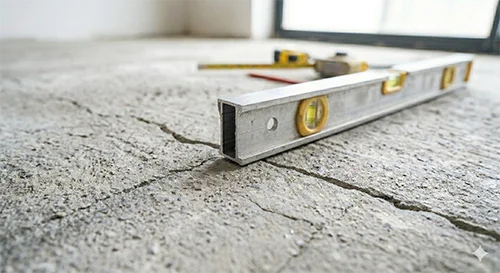
Straight Edge
Both Laminate and SPC require an even base, though Laminate is slightly more forgiving of minor grout line depths.
- Tile Requirements: Tiles must be 100% even. If there is any "lippage" (one tile sitting higher than its neighbor), the floor must be ground down or screeded over. For SPC, all grout lines must be filled in to prevent the rigid core joints from stressing over the gaps.
- The Solid Base Rule: If your tiles are not solid (hollow or loose), they must be removed. If they are solid but not flat, a smoothing compound over the tiles is required.
- Parquet & Wood Uplift: Existing solid parquet wooden blocks must be removed. Parquet is prone to swelling from trapped moisture, which will push up and ruin your new floor.
- Rule of Thumb: If you uplift tiles or parquet, you will almost certainly need a self-levelling smoothing compound afterward to restore the surface.
LVT (Glue-Down)
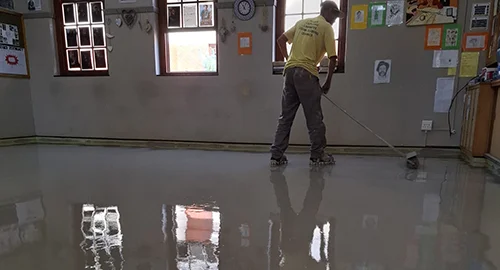
Screed Rolling
LVT requires a glass-smooth surface for a successful bond.
- Installing Over Tiles: To install LVT over existing tiles, you must first apply a specialized "Slush" primer followed by a smoothing compound. Over tiles the screed generally needs to be applied thicker, around 5mm to 6mm.
- Handling Different Floor Levels: If there is a height difference between two rooms (e.g., from tiles to concrete), a structural ramp can be made over about 30cm using screed to create a seamless transition.
- Uplift Requirements: Existing carpets and underlay must be removed. Epoxy and painted floors must be chipped or ground away to expose the raw concrete so the primer and screed can bond correctly.
3. Moisture Barriers: The Silent Insurance Policy
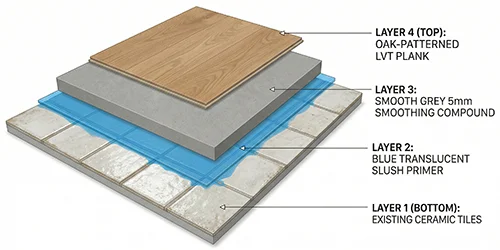
Screed Layers
- For Laminate & SPC: You must use a physical Damp Proof Membrane (DPM). We specify virgin high-density plastic sheeting of 80 microns or more. Alternatively, use a high-quality underlay with a built-in DPM, like 2mm Combi Lay.
- For LVT: A liquid moisture barrier is only necessary where existing damp issues are identified. It must be applied at least 24 hours before applying any smoothing compound.
4. Smoothing Compound vs. Self-Leveling
There is a general misconception that "Self-Leveling Screed" will fix a slanted house. A better term is Smoothing Compound.
- The Reality: These compounds are generally applied only 3mm to 7mm thick. They create a smooth, flat surface, but they do not make a structural floor "level."
- Pre-Filling: If specific areas are significantly uneven, these must be identified and filled in before the final surface screed is applied.
- Recommendations: While Laminate seldom requires it, a smoothing compound is highly recommended for SPC and is a non-negotiable requirement for LVT.
« Previous Article
Next Article »